










Private Administrative Process
(Concepts Overview)

There are Seven Main Concepts that will help make the administrative procedure make sense to a “layperson” with no previous experience. All the supported evidence and case law, maxims, etc. are being provided with links below for each concept, for your convenience and further investigation.
Using a Private Administrative Process, you can get a lawfully binding contract with a debt collector, bank, mortgage company, any State or Municipality (including the USA), any party with beef who might sue you, IRS, or even your ex-spouse. You can use this to get any company to Cease and Desist, stop collection attempts, reverse a lien/levy/garnishment, and basically resolve the issue entirely.
The administrative process can be helpful pre-lawsuit (pre-foreclosure suit, pre-credit card lawsuit), or during the lawsuit process (after you’ve got a summons to answer to court). You can also attempt to resolve it AFTER you lost and have a Judgment, but the process is MUCH harder once you have a Judgment.
If you need help with starting an administrative process, or deciding if can be useful for particular situation(s), we suggest you select a mentorship package that best suits your interest & goals. Visit the mentorship calls page and call us at 1-877-891-8384 to discuss and decide.
UCL’s Overview on PRIVATE ADMINISTRATIVE PROCESS:
Concept One: There Is No “Money” as Defined in the U.S. Constitution
In our society today, due to the major Bankruptcy in 1933 [look up “HJR 192”], all “money” is debt, not assets. It is even printed right on the front of all Federal Reserve Notes: “This Note is Legal Tender For All Debts, Public And Private.”
In the past, US Dollars were actually based on Gold or Silver and were merely a receipt which could be exchanged for this real money of substance.
So now, you have realized that no asset of any value was loaned to you. What is really happening is that your signature on a loan application is what authorized the bank to access your own credit, which is unlimited in your lifetime, based off your birth certificate (which is a bond).
Credit is created through bonds, promises to pay, and based on the commercial energy of the living person whose autograph/signature is affixed to the document. Strictly speaking, when you sign the loan application, you are placing a lien on the birth certificate — which is an asset and also the Title to your body or physical person. You are an asset and you are the source of the money. The piece of paper with your signature is now a security and has value. You are exchanging that note (an asset) for debt (as “Credit”).
The banks only deal in Credits and Debits based on book entries. Look in your online banking or paper statements — the only two ledgers you see are “Debits” and “Credits.” Nowhere does it say “Money.”
In addition, it is now public policy (Public Law 7310) that the “payment of debt” is now against Congressional and “public policy” and henceforth, “Every [debt] obligation… Shall be discharged.” What this means is that you can send your bills to the United States Treasury or the IRS (their auditor), and they will discharge or “set off” your debt with your unlimited credit. This process is called “Accepted for Value.”
However, for the majority of people, this procedure is not recommended until one recognizes the inherent power that they have and is responsible enough to do the procedure effectively. We usually talk with our clients to discuss the best procedure for their unique situation — however all procedures will use all seven of these concepts listed on this page.
As a result of HJR 192, from June 5, 1933 forward, no one in this nation has been able to lawfully pay a debt or lawfully own anything. The only thing one can do is tender in transfer of debts, with the debt being perpetual. This substance was replaced with a “PUBLIC NATIONAL CREDIT SYSTEM” where debt is “LEGAL TENDER” money.
- How Money Is Created (Video)
- House Joint Resolution 192 (1933) / Public Law 7310
Concept Two: An Unrebutted Affidavit Stands as Truth in Commerce
For Demand or Proof of the Debt, the banks have never responded to our inquiry properly. Therefore they consent to our Affidavit of Facts and our New Contract.
“If only one side of the conflict was supported by affidavit, our task would be relatively easy, for we may not assume the truth of allegations in a pleading which are contradicted by affidavit.” — Taylor v. Portland Paramount Corp., 383 F.2d 634, 639 (9th Cir. 1967).
“Where affidavits are directly conflicting on material points, we do not see how it is possible for the district judge to ‘weigh’ the affidavits in order to resolve disputed issues.” — Data Disc, Inc. v. Systems Technology Associates, Inc., United States Court of Appeals, Ninth Circuit, July 13, 1977.
Concept Three: Authenticated Statement of Account
This International Commercial Law basically shows that a debt is considered discharged if the debt collector / original “Creditor” fails to reply and rebut your Affidavit of a Zero Balance. This is yet another process we use to demand proof of any authentic debt, which the banks/debt collectors never properly respond to.
UCC Article 9, Subsection 210
(1) A debtor may sign a statement indicating what he believes to be the aggregate amount of unpaid indebtedness as of a specified date and may send it to the secured party with a request that the statement be approved or corrected and returned to the debtor.
(2) The secured party must comply with such a request within two weeks after receipt by sending a written correction or approval. If the secured party without reasonable excuse fails to comply, he is liable for any loss caused to the debtor thereby.
(3) A debtor is entitled to such a statement once every six months without charge. The secured party may require payment of a charge not exceeding $10 for each additional statement furnished.
Concept Four: Fair Debt Collection Practices Act (FDCPA)
More public law to support consumers and our efforts at validating the debt.
§ 809. Validation of Debts [15 U.S. Code § 1692(g)]
(a) Within five days after the initial communication with a consumer in connection with the collection of any debt, a debt collector shall send the consumer a written notice containing:
- The amount of the debt
- The name of the creditor to whom the debt is owed
- A statement that unless the consumer, within thirty days after receipt of the notice, disputes the validity of the debt, the debt will be assumed to be valid by the debt collector
- A statement that if the consumer notifies the debt collector in writing within the thirty-day period that the debt is disputed, the debt collector will obtain verification of the debt
- A statement that, upon the consumer’s written request within the thirty-day period, the debt collector will provide the name and address of the original creditor
(b) If the consumer notifies the debt collector in writing within the thirty-day period that the debt is disputed, the debt collector shall cease collection of the debt until verification is obtained and mailed to the consumer.
(c) The failure of a consumer to dispute the validity of a debt under this section may not be construed by any court as an admission of liability by the consumer.
Concept Five: Tacit Acquiescence Is Acceptance
This explains how we get the companies to “agree” with our new contract that the debt is settled/discharged/zeroed out.
Definition of “Tacit Acquiescence”: Conduct recognizing the existence of a transaction and intended to permit the transaction to be carried into effect; a tacit agreement; consent inferred from silence.
For example, a new beer company is concerned that the proposed label for its beer might infringe on the trademark of its competitor. It submits the label to its competitor’s general counsel, who does not object to its use. The new company files an application to register the label as its trademark and starts to use it on the market. The competitor does not file any objection. Several years later, the competitor sues — but a court will refuse the accounting, since by its acquiescence the competitor tacitly approved the use of the label.
Similarly, the IRS may acquiesce or refuse to acquiesce to an adverse ruling by a lower federal court. Acquiescence is not the same as Laches — acquiescence relates to inaction during the performance of an act, whereas laches is the failure to sue until after several years have elapsed.
Concept Six: Contracts Can Move & “Holding Your Contract”
You have already probably received “New Terms” for your credit card, or notices of new terms for collecting unemployment amounts or social security amounts, etc. Any contract can change and this is supported and agreed by the other party if the other party does not respond in order to re-negotiate those proposed new terms.
Within 72 hours (actually 10 days — for mail to go to and fro), a new contract is agreed upon if you fail to respond. However our process is allowed to change old contracts using another concept called “Nunc pro tunc” — Latin for “Now For Then.” Any contract can move or be changed.
Basically, we just want you to understand that we are moving the contract from what was once an agreed-upon obligation (because of your conduct — you were paying it, weren’t you?!) — to now being an unsubstantiated or frivolous claim that has been rebutted by law.
Concept Seven: Certificate of Non-Performance (Dishonor)
Within the Uniform Commercial Code (UCC) is a process called a “Notary Certificate of Default Method” (Notary COD method). This has generally been used by banks in their commercial transactions, but more recently has been used in disputes with government agents, agencies, banks, and corporations by people unable to afford the services of an attorney.
It can be used to head off potential litigation, settling of the case prior to its being brought into court, or sometimes for a case that is already in court. It is a process of re-presentation of commercial documents that were previously presented and ignored, in order to gain response and satisfaction of your claim/inquiry.
The COD is a 3-step process performed by a notary after you have made a good faith effort to settle the matter with your opponent. You then bring the matter to the notary and request s/he re-present your documents to your opponent as a third party witness to their dishonor. The notary invites them to respond within a specific time frame, offering a follow-up notice if there is no response. If no answer is forthcoming, a Certificate of Dishonor / Non-Performance is issued.
If the Respondent fails to reply, or replies but does not answer your questions or provide the proof you requested, you can bring the issue to a notary who is familiar with the COD method. Generally, the notary will contact the Respondent twice. If no response is received, the notary will issue a Certificate of Dishonor — which can be brought before a judge for a Declaratory Judgment or used as the basis for a lien.
We contract with others who have been trained and who can help you with your COD. Contact us for more information.
Concept Eight: Due Process
This explains how when Due Process/Proper Notice is given in your proceeding (paperwork process), you are giving them all Equal Protection and the right to default, acquiesce, or contest.
“Due process requires, at a minimum, that an individual be given a meaningful opportunity to be heard prior to being subjected by force of law to a significant deprivation… the right to be heard ‘has little reality or worth unless one is informed that the matter is pending and can choose for himself whether to appear or default, acquiesce or contest.'” — Sniadach v. Family Finance Corp.
Process Flowcharts & Next Steps
Here are our videos on helping you understand the Private Administrative Process and showing you specifically document samples of what is used:
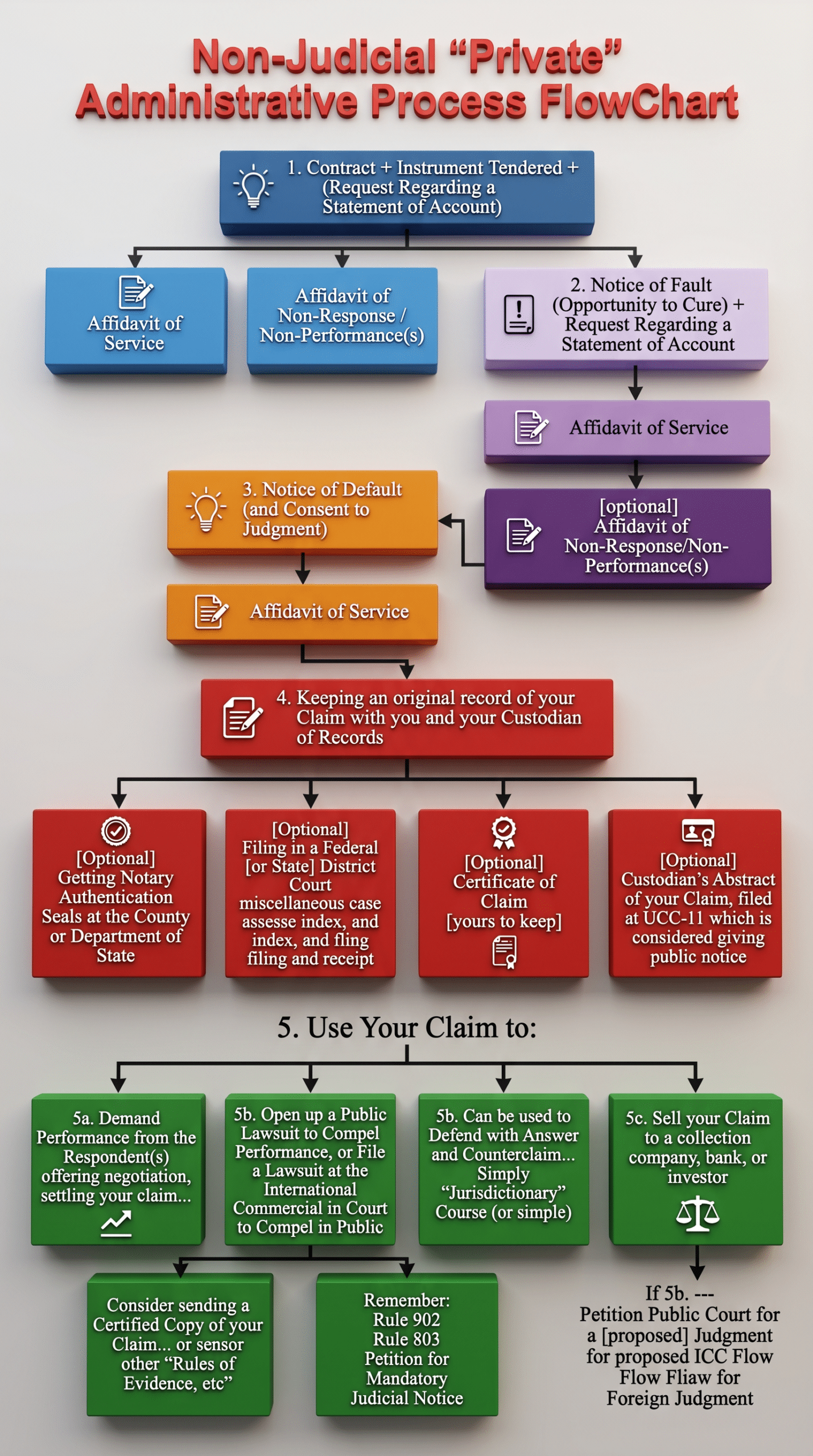
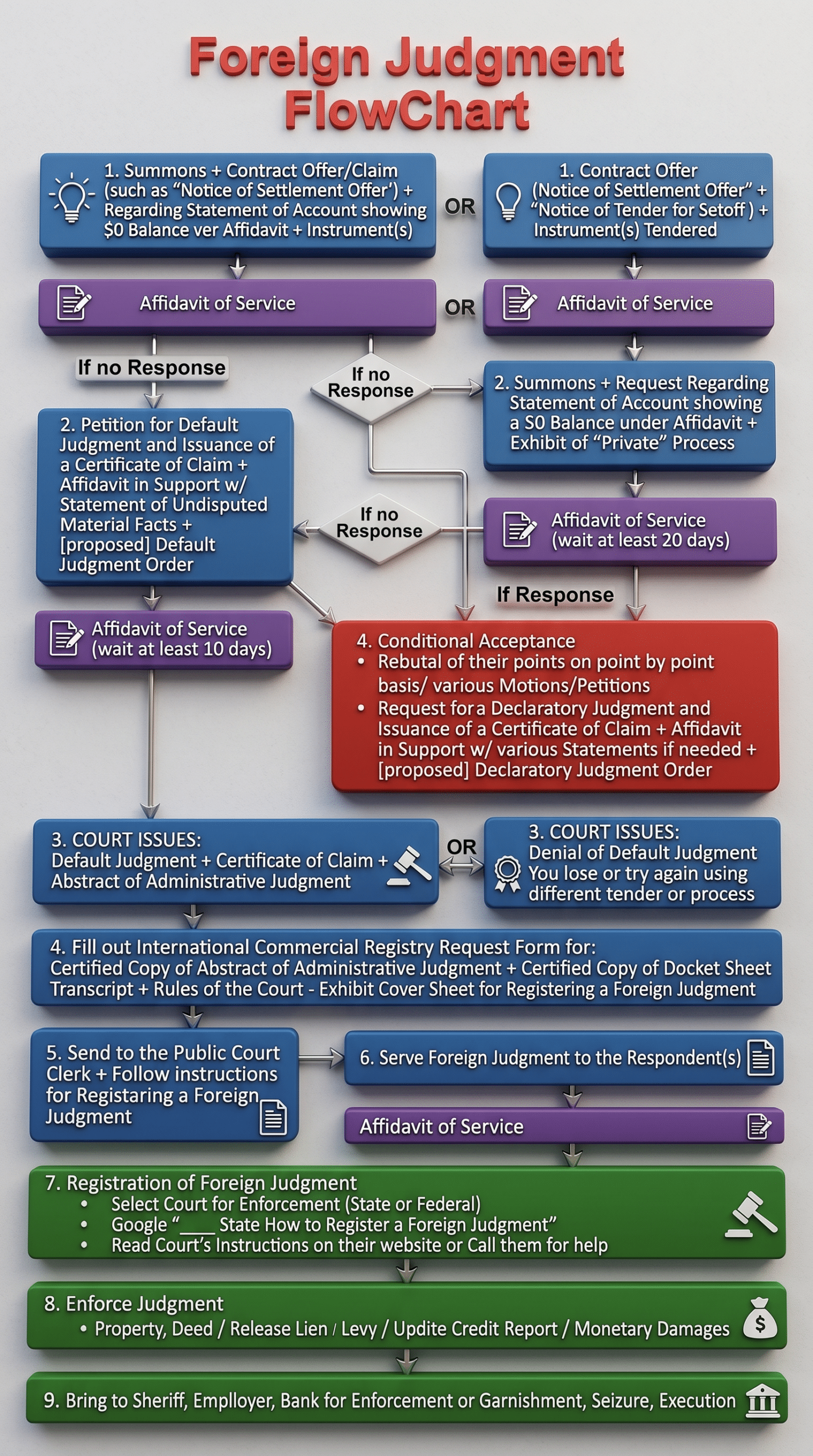
BELOW: Here are our Outlines for the Two Distinctly Different Administrative Processes.
You can discuss on a consultation the pros/cons (our opinion) of doing the Non-Judicial Admin. Process vs. the Foreign Judgment Process. Inquire by calling 1-877-891-8384 to evaluate if this is something our experts are available to assist you with.
The following below is a sample of what some people use or have used in the past to attempt to enforce their private administrative record of private consent decrees/settlements, with claims already adjudicated by agreement, to become a publicly recognizable judgment. This is an old outline here for research purposes — there are updates and more effective modalities available. The outline above, with slight modifications, should be sufficient to enforce most claims without the bottom flowchart being necessary.
For more information and tips and pointers, make sure to acquire the CONTRACT LAW BASICS BEGINNER’S COURSE.

EDU Courses & Lessons
If you’re looking to take advantage of the world’s best tools for sovereignty and freedom, you’ll want to engage with Tyler UCL as often as possible. You’ll gain real clarity on your next steps in just one hour of legal mentorship and life coaching, and you’ll develop a true ally who is not only a genius, but authentic, emotionally vulnerable, and genuinely wants your friendship. In life, we all learn that we cannot succeed alone.