










The Written Record
The following is not legal advice.
“It is not deeds or acts that last: it is the written record of those deeds and acts.”
— Elbert Hubbard (1856–1915)
All parties should have extensive opportunity to develop a written record. The written record should consist of relevant documents and statements or claims by the parties. It should contain evidence of activities and events, communications, and witness testimony. Overall, it is an account of administrative procedure and due process of law.
The nature of the subject matter of the record indicates what venue or jurisdiction one or both parties might be operating under. Whatever law form or forms are governing the record or the contract(s) should be addressed at the beginning stage of establishing a written record.
The Written Record: Historical Context of Record-Keeping
Now for some interesting and fun history on ancient record-keeping. See the full article at: Investopedia – Ancient Accounting . The following are excerpts.
Ancient accounting methods emerged thousands of years ago—perhaps more than 10,000 years ago—in what we now regard as the Middle East region. Sumerians in Mesopotamia, Babylonians, and the ancient Egyptians recognized the need for counting and measuring the results of labor and effort.
As these ancient societies built more complex civilizations, the need to conduct simple arithmetic, writing, and trade emerged. These ingredients eventually led to the formation of currency, capital, private property arrangements, and systems for commerce and public management.
As a result, various accounting techniques were used to keep track of agricultural products and land use, maritime and land-based trade, animals, and labor. Taxation, public works projects, military initiatives, and conquest eventually necessitated record-keeping as a way for rulers and their advisors to maintain social order.
Earliest Accounting
Jericho, an ancient city located near the Jordan River in the West Bank, is estimated to be at least 11,000 years old and is one of the oldest continuously inhabited cities. It is believed that this society used a barter system until about 7,500 B.C.
Simple tokens and clay balls with various shapes came to represent inventory figures for agricultural goods including wheat, sheep, and cattle. Tokens and envelopes later helped formulate an ancient version of what may be considered a balance sheet .
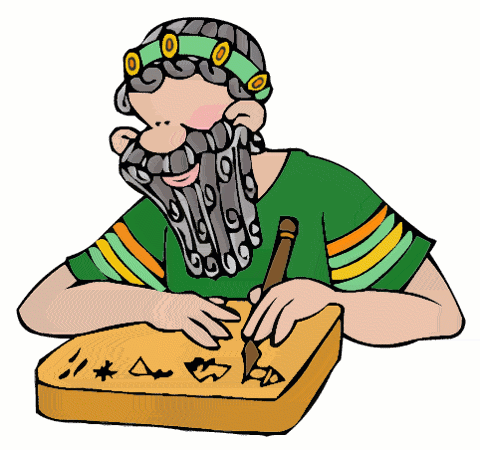
Thousands of years later, in Sumerian cities, early bookkeepers accounted for currency, precious metals, and goods by marking clay tablets with the ends of sticks. These tablets were dried and hardened to form permanent records.
Egypt used pictures, words, and numbers to track agricultural production, religious ceremonies, monument construction, public works projects, and labor control. Egyptian rulers enforced accuracy through fear and punishment. Irregularities found by royal auditors resulted in fines, mutilation, or death.
The Code of Hammurabi to the Roman Empire
The Code of Hammurabi was created around 1760 B.C. in Babylon. Among its purposes, the code standardized weights and measures and provided guidance on commercial transactions and payments.
The emergence of accounting in ancient Greece supported its financial and banking systems. The Greeks’ adoption of the Phoenician writing system and the invention of a Greek alphabet facilitated record-keeping.
Similarly, accounting underpinned the Roman finance and legal system. Combined with the use of currency beginning around 300 B.C., Rome’s advanced commerce system helped propel its geopolitical power far beyond its rivals.
Accurate and timely record-keeping—even thousands of years ago—enabled critical decisions. In modern accounting systems, methods are more complex, but the need for accuracy remains unchanged.

EDU Courses & Lessons
If you’re looking to take advantage of the world’s best tools for sovereignty and freedom, you’ll want to engage with Tyler UCL as often as possible. You’ll gain real clarity on your next steps in just one hour of legal mentorship and life coaching, and you’ll develop a true ally who is not only a genius, but authentic, emotionally vulnerable, and genuinely wants your friendship. In life, we all learn that we cannot succeed alone.