









Accepted For Value Doesn’t Work? What Works Instead
Many people surfing around the internet for stories or instructions on the Accepted for Value Redemption Process normally hit a brick road, get caught in information paralysis, or aren’t able to have the ability to enforce their discharging of their debt.
We have been getting over 200 phone calls and e-mails per week for over 3 years, from people all over the world requesting we help them with one issue or another — so I think we are qualified to provide some feedback on what is working and what is not.
We will do future blog posts with more insight, so stay tuned!
First, hopefully this article will be able to clear up what is working, how to get it to work, and provide a new foundation for your understanding and application.
The information provided is for entertainment purposes only!
-
Definition of Accepted for Value
Accepted for Value is also known as “Bankers Acceptance” and according to Wikipedia, it is defined as follows:
Banker’s Acceptance is a promised future payment, or time draft, which is accepted and guaranteed by a bank and drawn on a deposit at the bank.
The banker’s acceptance specifies the amount of money, the date, and the person to which the payment is due.
After acceptance, the draft becomes an unconditional liability of the bank.
But the holder of the draft can sell (exchange) it for cash at a discount to a buyer who is willing to wait until the maturity date for the funds in the deposit.
Concept and Interpretation
Winston Shrout points out that one of the maxims of commercial law is that whoever provides the liability is the one who must also provide the remedy.
So therefore you are hit with a bill or a debt — but because DEBT IS MONEY since the elimination of the backing of the currency by precious metals, the commercial world is an admiralty system in which there is forgiveness for your debts.
In Matthew 6:12, in the Christian bible it says forgiveness of your “sins” but in some versions of the bible it says “debts”:
And forgive us our debts, as we also have forgiven our debtors. — Matthew 6:12
So the “hidden” commercial remedy to all of us — is that we can “accept” our bills, invoices, statements, or any evidence of debt by signing them — bringing life to the instrument — and return it “for value” (for the value that the total balance stated on the invoice), and return them to the one issuing the instrument in order to discharge the charge.
In accordance with Black’s Law Dictionary’s definition of Bankers Acceptance, and in accordance with Biblical Law, and HJR 192/Public Law 7310 (the removal of precious metals backing the U.S. and most of the world Currency).
This is no different than most Americans do every day — transferring Federal Reserve Notes “for value” — i.e. “For the Value” of $1, $20, or $100 that is written on them in order to discharge our debts.
The notes are backed by no precious metal or any asset, but are only traded on “good faith” and “acceptance” of the number that is printed on it.
We are “Accepting” the value of $20 on the face of the instrument as a Positive Number, doing an accounting to discharge those who owe us $20, and Returning it for full settlement of the account.
The bottom line thought is that the bank or creditor will want some form of public currency, so they will not go along with this and call it “nonsense.” And in our opinion, if it DOESN’T WORK — then Yes, it is nonsense. We are not of the opinion that we run our lives on THEORY.
There are, however, many processes that DO WORK to challenge your debt with corporations (not private individuals), in COURT using time tested and proven processes — which, if you connect with us we can guide you to some things that actually work, and show you some real life case studies of people we’ve helped.
A4V doesn’t work at all — it’s just theory. We know of nobody in the past 2 years who has gotten it to work… and we get 200 calls/emails per week!
The similarity of A4V and giving FRN’s, is that they are both worthless pieces of paper except the value printed on it is “accepted” by the other party. The difference is that if you are a Secured Party Creditor, the A4V actually places a lien on your birth certificate estate (or stock certificate in the USA corporation).
These birth certificate bonds have a value and are being traded and you used to be able to look up their value on Fidelity with the CUSIP number (birth certificate number). The government uses the birth certificates as collateral in order to take out more loans from the International Creditors like the IMF, Rothschild European banks, etc.
Again, the important concept to remember about sending the Accepted For Value Endorsement, is that all money is just evidence of a debt, and the value is speculative and that any note, bond, or bill is only as good as the value it is accepted for. So, if you send it to them and they keep it, you can prove that they have accepted it and your debt is now no longer your obligation (discharged).
-
Accepted for Value Goes Viral
The internet sensation around the Accepted For Value craze hit back in 2008 with a Talkshoe conference recording by Doug Riddle about a string of apparent Accepted For Value successes, short-termed by the niche students desperate to find a lottery-ticket way to pay off their debts effortlessly as “A4V” or “AFV”.
The apparent successes and first-hand accounts excited many who have been distasteful of the government, IRS, and big corporations — people who think that “maybe there is a hidden hole out of the planet prison after all?”
For the next few years, the Accepted For Value sensation “went viral” in a small sect of “Patriot,” “Libertarian,” and “Constitutionalist” sects of Ron Paul supporters, Alex Jones fans, and Old-School Constitutionalists. But it created its own breed — a much more niche sect of researchers desperate to save their homes from foreclosure or unable to pay back credit card debts.
The financial collapse in 2008 created a huge spike in people trying to find a way to stop or delay foreclosure and save their homes. A new research community — those working with or without lawyers combined with those studying “How to Win in Court/Jurisdictionary” — all converged together on talkshoe.com and various private membership websites.
Doug Riddle Method
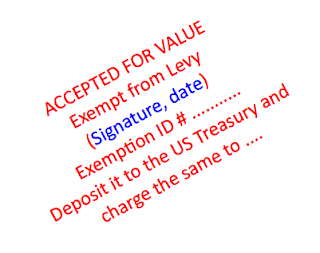
The instructions on Doug’s talkshoe were quite simple: write “Accepted for Value Returned for Value Exempt From Levy, Deposit to the U.S. Treasury and Charge the Same to JOHN H DOE 123-45-6789 ADJUST THE BALANCE TO ZERO” — or something to that effect — and mail it to Stop 4440 in Ogden, Utah, care of the Internal Revenue Service (Criminal Investigation Division).
For people that feared sending their Accepted for Value notices to the IRS, especially asserting a right and sending to CID — that was a hard jump. Many hesitated and feared, but saw others get remedy… for a few months.
Well after a few short months, people stopped getting their bills discharged through A4V. Over the next eight years, the rate of successes by this simple process has reduced to “0” — yet Doug Riddle and Winston Shrout still sell A4V Videos and Coaching.
Why did it work? Was it a diversionary “smoke and mirrors” tactic to lead people in the wrong direction? Or were there factions in the IRS allowing this to work to lead us down to a more powerful remedy only a few steps away?
Regardless, now everyone who tries the “Doug Riddle A4V Method” reports back that it doesn’t work. They call the IRS to ask about their A4V and are told they know nothing about it — and there are posts all over the internet mentioning the process as a scam.
-
Administrative Process
A few years later, Commerce Coaches and teachers like Brandon Alexander Adams, founder of CreditorsInCommerce.com, pieced together his teachings from Doug Riddle and Winston Shrout’s Accepted for Value process in order to create an enforcement outline. He started teaching private workshops around the country teaching the administrative enforcement process — sometimes called “Administrative Procedures” or “Administrative Process.”
“The purpose of an Administrative Process…is to procure a record,” Brandon says in one of his latest CIC/MIC Seminars. He goes on to teach how important it is to create an admissible record to which one can submit as evidence into a court, and for the Judge to take judicial notice of that record, so that he can rule in your favor and have your Claim recognized by the Public Court System.
It is such a powerful and involved process with much intricate detail, that a beginner should seek a coach to walk them through the entire process. But even so — trying to get the court to enforce an A4V is a longshot for most. All we have seen is that if you put up enough determination and tenacity, the opponent will likely drop their charges or cut you such a sweet deal that you will be silly not to take it.
Now, there are other type of processes similar to A4V like sending a new (second) promissory note to the bank/creditor, and enforcing that. And of course, if you’re going to need to force your process of a discharge to get recognition through the courts — in order to compel the bank (or whomever) to zero the account and cease and desist collections — obviously the A4V process is usually only going to be appropriate if you are: a) out of options, b) can’t afford to make your payments otherwise, and c) do not need the service anymore.
What I am saying is that you can’t continue making monthly credit card payments and then sue the bank to get your private promissory note, A4V, or instrument of choice to work. If it’s something you’ve “walked away from,” then you can do it — if you find it’s worth your time.
If you have a $1,000 credit card you can’t pay anymore, it might not be worth your time to open up a lawsuit over something that small. I recommend if you can’t pay a few small bills, just walk away from them, move on, and try to work on something constructive like starting your own online business.
High balance and don’t need the service? Well in that case, you may wish to try this, or you may wish to do the debt verification procedures, coupled with preparing for a Federal Lawsuit based on FDCPA and FCRA. In those cases not only do you have the attorneys, courts, and judges ON YOUR SIDE — but you can actually win MILLIONS against the bank.
Brandon himself pays his mortgage and doesn’t hide the fact. He agrees, and we agree — the public remedies (FDCPA, Verification of Debt, etc.) work much better than the theoretical private-side stuff like A4V and enforcing private promissory notes.
EFT — Electronic Funds Transfer
Another process that people are trying besides Accepted for Value — known as “EFT” or Electronic Funds Transfer — is being taught, and apparently there is a way to use your closed checking accounts to set off debt. Black’s Law Dictionary defines “closed account” as “used for setoff and adjustments.”
The electronic funds will “transfer” but if you still don’t know the whole puzzle picture, it will likely only get reversed shortly thereafter — and the naive student who doesn’t know how to rebut presumptions might be facing criminal charges.
Both Winston, Brandon, and us at UCL say: STAY AWAY from EFT unless you know what you are doing!! We ourselves have done it, but we had to go to court in a foreclosure case in order to show it and get the judge to admit that we paid the bank. So — be prepared to get your feet WET or don’t do it!
You can become a Private Member of our site and log in to visit the “Administrative Process” section, to view some Accepted For Value success story examples for Credit Cards, Hospital Bills, Mortgage, etc. — but realize that NO ONE PROCESS will duplicate exactly like another. Everyone is looking for a magic easy remedy — but be aware that none exists and you need to study and learn to enforce your process or it won’t stick!
-
Proceed Forward With Caution
We too, here at UnderstandContractLawAndYouWin, after doing this for more than 4 years, have seen way too many people lose and lose big due to lack of knowledge and lack of experience with Accepted For Value-esque type processes or procedures.
When the stakes are high and you have a lot on the line — potential lien, levy, garnishment, repossessing your vehicle, or seizing and foreclosing of your home — you want to proceed forward with caution if you do decide to do any of this.
- Get a mentor, study a lot, and/or work with someone competent who has had successes already.
- Ask them for proof and testimonials.
- Make a grounded, sensible choice — then take full 100% responsibility for your choice(s).
- Be prepared — if the stakes are high you might need to go to court. Learn a little about the Public court procedure process as well (recommended: “How to Win in Court” course).
For your entertainment and learning, we at UCL have been watching the likes of Brandon, Winston, Doug Riddle, and all the A4V gurus — and piecing together what works — and have been updating our niche community of students who decide to support our work by their donations to our cause.
We have helped many people by walking them through, explaining and showing examples of what is currently being used successfully across the continent and even across the world in Australia, Canada, the U.K., and elsewhere. It has taken many years to get narrowed in on exactly which documents to use and which ones are getting consistent results.
The Bottom Line
The “simple” Accepted for Value (A4V) Successes you read about on the internet are only in 1% of the cases and aren’t really even happening anymore. The IRS special offices are not processing them anymore, and our students are no longer sending the instruments to the IRS — but are doing a new process and sometimes have to go as far as to get enforcement in the courts through submitting certain filings and records, and possibly showing up or appointing an assignee or trustee to appear for them.
Conclusion
Hopefully now you have more insight into understanding Accepted For Value! More blogs by us about Accepted for Value: Accepted For Value Defined and Demystified
-
Membership and Contact
If you need help or guidance about Accepted for Value or any other Commercial Redemption process, we also provide private coaching sessions for a donation of as little as $50 or $100.
To learn more about our services and to be put into our private membership list (it’s free), where you may be invited to private conference calls and see special offers for our services and products, make sure you join our private membership announcement list:
If you sign up, you can then call us at 505-340-3632 and get a free 10-minute consultation on anything related to Accepted for Value or Commerce, Sovereignty, Law, etc.
(Note: We cannot and do not give “legal advice.”)

EDU Courses & Lessons
If you’re looking to take advantage of the world’s best tools for sovereignty and freedom, you’ll want to engage with Tyler UCL as often as possible. You’ll gain real clarity on your next steps in just one hour of legal mentorship and life coaching, and you’ll develop a true ally who is not only a genius, but authentic, emotionally vulnerable, and genuinely wants your friendship. In life, we all learn that we cannot succeed alone.